
How AI (LLM) Works?
AI systems such as ChatGPT can seem complicated because many different technologies are involved. However, the basic idea behind a large language model, or LLM, can be explained quite simply.
The easiest way to understand an AI like ChatGPT is this:
It is a giant prediction machine for language.
Not a database.
Not a search engine.
Not a digital person.
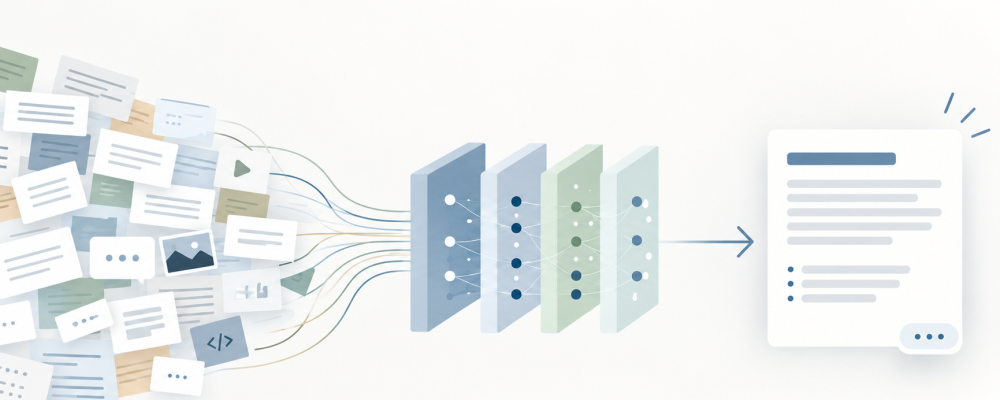
It has been trained on enormous amounts of text, and during training it has learned to recognize connections between words, things, facts and different ways of expressing ideas.
The basic idea: what comes next?
Suppose you write:
The capital of France is…
A likely continuation is:
Paris.
Or:
Water freezes at…
A likely continuation is:
0 °C.
An LLM works in a similar way. It looks at the text it has received and calculates what is most likely to come next.
It then adds a small piece of text and repeats the same process.
The answer is created piece by piece.
This sounds simple, but the system making the prediction is extremely large and has learned an enormous number of different connections.
It does not look only at the last word. It can make use of the entire conversation, instructions, examples, documents and other information that has been provided to it.
How does it learn?
During training, the model is given enormous amounts of text.
For example, it might see:
The cat is sitting…
The model tries to predict what comes next.
If the prediction is wrong, the system slightly changes the internal numbers that affect how it behaves.
This happens again and again across enormous amounts of text.
Over time, the model becomes better at predicting language.
To do this well, it also has to learn many of the connections that appear in language.
For example, it can learn that:
- Paris is connected with France
- ice is connected with cold and water
- doctors are connected with patients and medicine
- programming code follows certain rules
- questions are usually followed by answers
- instructions require a different kind of response than stories
Nobody manually enters all of these connections into the model.
The language model learns them during training.
What is actually stored inside the model?
Mostly numbers.
A large language model contains an enormous number of numerical values that are adjusted during training.
Together, these numbers represent the structures and connections the model has learned.
There is usually no single place inside the model where a fact such as this is stored:
Shakespeare wrote Hamlet.
Instead, this information emerges from many learned connections working together.
This is why an LLM is different from a database.
A database stores exact records.
An LLM stores learned patterns and connections.
Does it remember everything?
No.
Some information can become very accurately represented in the model, especially if it appeared many times in the training data. However, much of the model’s usefulness comes from learning general patterns.
For example, you can ask it:
Explain electricity using water flowing through a pipe as an example.
That exact sentence may never have appeared in its training data.
However, the model has learned enough about electricity, water pipes, comparisons and explanations to combine those ideas into a new answer.
This ability to apply learned patterns to new situations is called generalization.
Why can it answer so many different kinds of questions?
Language contains information about almost every area of human activity.
Books, articles, manuals, websites, programming code, discussions, scientific writing and many other sources contain information and patterns about topics such as:
- history
- science
- software
- business
- law
- mathematics
- writing
- everyday life
By learning from large amounts of text, the model develops useful ways of handling many of these subjects.
This does not mean that it knows everything.
It means that it has learned enough patterns to produce useful answers across many different areas.
A language model can process more than text
Although the basic idea of a language model is easiest to explain using text, AI models can also process things such as images, audio and other information provided to them.
The basic principle is still similar: the system converts the information it receives into a numerical form that the model can process, and then looks for learned connections and structures within it.
This is why AI can, for example, examine an image, read a document or use other computer programs in addition to having a text conversation.
What happens when you ask it something?
Suppose you ask:
Why is the sky blue?
The model receives your question and processes it together with the rest of the available context.
It then calculates several possible ways to begin the answer.
It selects one small piece.
Then it calculates the next piece.
And then the next.
This continues until the answer is complete.
The model is not usually retrieving a finished answer from somewhere in storage.
It creates the answer as it is being generated.
The calculations happen so quickly that, from a human perspective, the answer can seem as though it simply appeared fully formed and ready to use.
Why can AI be wrong?
Because the model is designed to produce a likely and useful continuation of the text it has been given.
However, a likely answer is not always a true answer.
For common information, the learned connections can be very strong.
For example:
The capital of Japan is Tokyo.
But if you ask about a very obscure event, person, book or scientific study, the model may produce information that sounds believable but is incorrect.
This is often called a hallucination.
The most important point is this:
A well-written answer and factual accuracy are not the same thing.
An answer can sound clear and convincing while still containing an error.
Important facts should therefore be checked against reliable sources.
Training the model and using the model are different things
Training is the process through which the model learns.
During training, its internal numerical values are continuously adjusted.
When the trained model is put to use and begins producing answers, this stage is called inference.
During normal use, you provide the trained model with information, and it generates a response based on what it learned previously and what is currently included in the conversation.
Having a conversation with AI does not mean that the model retrains itself based on every message.
What does context mean?
The model can also use information that was not part of its original training.
For example, you can give it:
- a document
- a spreadsheet
- an email
- previous messages
- search results
- information from another system
This temporarily available information is called context.
If you give the model a company report, it can analyze the report even if it has never seen it before.
This is different from information learned during training.
Why are external tools useful?
An LLM is much more reliable when it can use specialized tools.
For example:
- a search tool can find up-to-date information
- a calculator can perform exact calculations
- a database can provide exact company records
- a calendar can show your actual schedule
- software tools can run and test programming code
This means the model does not have to guess when exact or up-to-date information is needed.
For example, if you ask:
What is today’s exchange rate?
a good system should check an up-to-date source instead of relying only on what the model learned in the past.
What is an AI agent?
An AI agent is a system in which a language model can complete a task in several stages instead of simply answering a single question.
A simple conversation works roughly like this:
Question → Answer
An agent can work more like this:
Question → Find information → Check the result → Take the next step → Produce an answer
For example, if an agent is asked to find a suitable hotel, it can search for options, compare prices and locations, remove unsuitable choices and finally present the best options.
The language model guides the process, but it can use other tools such as a web browser, calculator, calendar or other software.
The latest models, such as GPT-6 Astra and Grok 4.6, are designed specifically for these kinds of multi-step tasks, where the model uses tools and continues working based on the results they provide.
Why can AI be very good at one task and poor at another?
LLMs are not equally reliable across every type of task.
They are often very good at:
- explaining
- summarizing
- rewriting text
- translating
- working with text
- generating programming code
- finding patterns in information
They may be less reliable when a task requires:
- exact factual recall
- current information
- precise calculations
- very long chains of reasoning
- information that was rare or missing from the training data
This is why good AI systems combine language models with other tools and methods for verifying information.
In summary
A large language model (LLM) is a very large mathematical system trained on enormous amounts of text.
During training, it learns connections and patterns.
When you give it a message, it uses the patterns it has learned together with the current context to calculate what text should come next.
It repeats this process many times and builds the answer in this way.
That is the basic idea.
The system can appear extremely capable because language contains an enormous amount of information about the world. By learning the patterns that appear in language, the model also learns many useful connections between different things and ideas.
However, it is not automatically correct.
It works best when its strengths are combined with reliable information, external tools and fact-checking.